

FROM PITTSBURGH TO ACCRA TO HJØRRING, DENMARK: WHY IRON CITY FOOTBALL AND SPORTING CLUB EXISTS
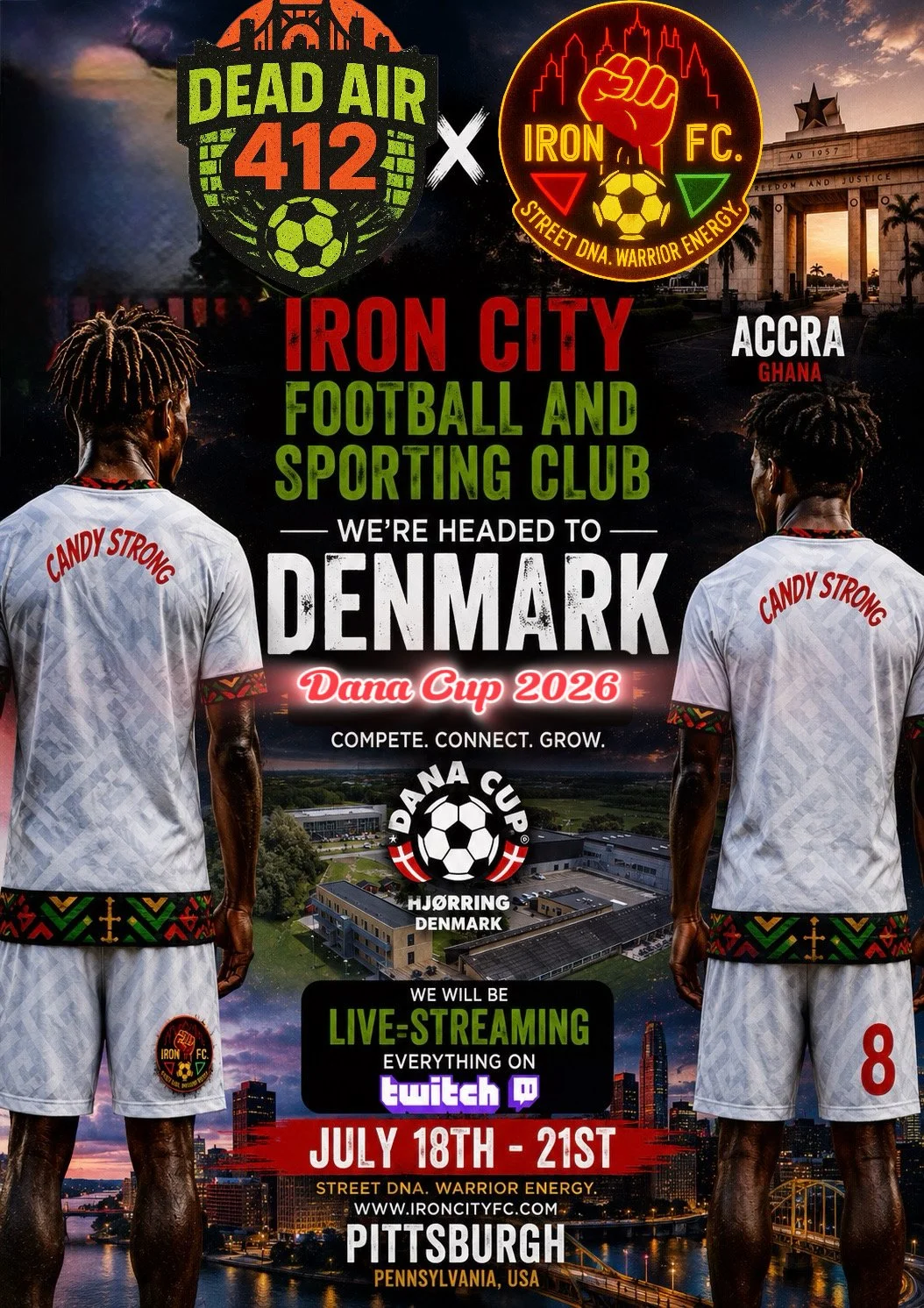
Most people will look at Iron City Football and Sporting Club going to the Dana Cup in Hjørring, Denmark and just see a soccer story.
Jerseys. Flights. Flags. A small club from Pittsburgh stepping onto an international stage.
But that’s not what this is.
This is about culture, identity, and building something outside of systems that were never designed for us.
For years, American soccer has been controlled by money, access, and connections. If you didn’t grow up in the right environment or have the resources for elite academies, the game quietly moved without you — even if you had the talent, the passion, or the love for football.
Meanwhile, neighborhoods across Pittsburgh were full of players, creatives, and communities where football wasn’t an “opportunity” — it was just life.
Iron City Football and Sporting Club was built from that reality.
Not from institutions.
Not from privilege.
Not from pipelines.
It came from street football culture, immigrant communities, local creatives, ultras mentality, and people who actually live the game every day.
That’s also why Dead Air 412 is tied into this project — because this was never just about sport. It’s about documenting culture as it actually exists, not how it’s usually presented.
WHY THE DANA CUP MATTERS
The Dana Cup is one of the largest youth football tournaments in the world, held every year in Hjørring, a small town in northern Denmark that temporarily becomes a global football hub.
Founded in 1982, it has grown into a massive international tournament that regularly features:
Around 1,000+ teams
Over 20,000 players, coaches, and staff
Clubs from 40–60+ countries
More than four decades of history
What makes it unique is the scale of participation and the diversity of football culture that shows up in one place.
For one week, Hjørring transforms completely. Schools, training fields, and local stadiums become part of a global tournament network. Teams from Africa, Europe, Asia, and the Americas all compete in the same environment, often playing multiple matches in a short span of time.
It’s not just about winning games.
It’s about exposure, experience, and measuring yourself against football cultures from around the world. Many players who go through the Dana Cup describe it as the first time they truly understand how global the game really is.
For a club like ours, that matters.
Because we’re not stepping into a local tournament — we’re stepping into a global football ecosystem where most teams are established academies with long-standing infrastructure, funding, and history.
We’re coming in as a grassroots project built from culture first.
THE JOURNEY BEYOND THE GAME
A club from Pittsburgh building connections that stretch from western Pennsylvania to Accra, Ghana and now to Hjørring, Denmark is not something that happens by accident.
It’s the result of intention, belief, and consistency.
During Dana Cup 2026, Iron City Football and Sporting Club will also host a press conference in Hjørring announcing a major step in the club’s long-term international vision.
That moment isn’t about attention.
It’s about proving that grassroots football can exist on an international level without losing its identity — without becoming something it was never meant to be.
The connection to Ghana is part of that same idea. Football has always been global long before systems tried to structure it. The soul of the game exists in places where it’s not commercial first — in streets, local pitches, and communities where football carries meaning far beyond sport.
That same energy exists in Pittsburgh.
Working-class neighborhoods.
Overlooked communities.
People told to wait their turn.
Kids who grow up loving the game but rarely see themselves reflected in how it’s presented.
Iron City Football and Sporting Club represents them.
WHAT THIS REALLY MEANS
This trip to Denmark isn’t a reward or a milestone.
It’s proof of concept.
Proof that culture can travel.
Proof that grassroots football can scale globally.
Proof that you don’t need permission to build something real.
Some people won’t understand it. Some never will.
But the movement keeps growing anyway.
The players keep showing up.
The supporters keep building it.
The creatives keep documenting it.
The culture keeps moving.
Dana Cup 2026 is just another chapter — not the destination.
From Pittsburgh to Accra to Hjørring, this is bigger than football now.
Street DNA. Warrior Energy. ⚒️